WISE

  • Home
  • About Us
    • Who We Are
    • Board of Directors
    • Junior Board of Directors
  • Events
    • All WISE & Industry Events
    • Annual Meeting
  • Membership
    • Corporate Partners Benefits
    • Individual Member Benefits
    • Membership Application
    • Our Partners
  • Professional Development
    • WISE Webinars
  • WISE University
    • Inclusive Excellence Learning Series
    • WISE Mentor Circles
    • WISE Resource Center
    • New and Emerging Manager Training
  • Volunteer
  • Media
    • Gallery
    • News and Press Releases
    • WISE World Newsletter
  • Contact
  • TWISB Awards
  • Member Login

Celebrate National Hispanic Heritage Month

September 15 marks the beginning of National Hispanic Heritage Month. The tradition of celebrating this vibrant section of our population began with a designated week in 1968. The week has since grown to a month to try to fully encapsulate the full influence that Hispanic Americans have had on our nation’s history and our culture. 

This cross-section of consumers is so integral that many companies focus events and product offerings to reflect the Hispanic influence. One of those companies is our WISE partner member, Fresh Texas. Fresh Texas, located in the heart of South Texas, creates plant-based, fresh produce-centric products that ship throughout Texas. We asked CEO Judy Clark, how the company incorporates the Hispanic Culture and celebrates National Hispanic Culture Month.
 
“We find our Hispanic culture to be a great source of innovation in our category. We look to the traditions of rich ingredients and spices that combine to create flavorful dishes. The cuisine lends itself naturally to creating flavorful plant-based meal solutions. Recently, we created items such as a Zucchini Noodle Salad with black beans, fire roasted corn, chipotle vinaigrette and tortilla strips; Deconstructed Stuffed Poblano Chile; and Burrito Bowls with Fresh Pico de Gallo and Sofrito. Melding traditional produce with the Hispanic flavors and spices turn ordinary fresh produce into a fresh take on Hispanic Cuisine.
 
During October, we will host events for our employees celebrating Hispanic Heritage Month. At Fresh, we actually speak over a dozen languages on our campus, so we love to celebrate cultural diversity! We host food truck days that showcase the flavors of the culture we are celebrating and educational slides that play throughout our Visual Factory. We have learned, that we can turn most any food truck meal into a taco… even spaghetti can fold up nicely into bread! Our Hispanic roots run deep here in South Texas.”
 
Here are some links that can assist you with learning the history of National Hispanic Heritage Month and ideas for how to celebrate:
Woman’s Day Article | Hispanic Heritage Foundation | Top 100 Most Influential Latinas | Hispanic Heritage Awards | Hispanic Heritage Stories – Latinx Perspectives 

Ahold Delhaize Leading a Culture of Diversity & Inclusion

Ahold Delhaize Leading a Culture of Diversity & Inclusion

Think about a time when you have felt excluded.  What came to your mind?  Perhaps it was something that happened in school or at work.  What kind of emotions do you remember? Posing that question is how Sarah Chartrand has opened discussions about diversity and inclusion.  “I want to help people see that the subject of inclusion is a human issue and one that we are all connected to,” she explains.  “But, not everyone feels exclusion at the same level.  It’s not an us versus them conversation.” 

Sarah, a self-described ‘retail geek’, is SVP of Talent Leadership & Diversity for Ahold Delhaize.  She is passionate about creating diversity and inclusion initiatives that generate genuine culture shifts within organizations.  While the business case for D&I is impactful, evoking an emotional impact within leadership can truly bring about change.  “When people connect with the emotions they feel when they are excluded or included, it can bring about a big realization.  Then, when we talk about groups who are more marginalized than others, and we can think about how marginalized groups feel, people are able to place this into a whole new perspective.  It’s powerful to explore how much we can do as leaders to include everyone, to create cultures where everyone can be themselves in the workplace.”

Long before this summer’s demonstrations of unrest in the U.S. brought a cultural microscope to diversity, inclusion and equity, Sarah has been advising that leaders “do the right thing” not only for their bottom line, but also for their employees and their customers.  Sarah points to research from Harvard Business Review that showed that companies with diverse talent are 45% more likely to report growth and 70% more likely to capture a new market.  There is a definitive business case for D&I, but that’s not the only reason to focus on this.  “Companies are absolutely going to see a return on investment when they place a full customer lens on business decisions.  And this cannot be done unless your team is representative of a customer.  One person alone cannot bring the lens of all customers,” explains Sarah.  “The case for D&I goes beyond the ROI. It’s about creating a space where everyone can succeed, where there is equity for everyone.  Companies traditionally focus on placing the right people in the right roles at the right time.  This can only be done when you have a truly diverse talent pool to draw from.  Leaders need to stand up and question this – are we considering all available talent?  Is our talent pool truly representative of our customer base?  We have to be authentic, brave, and honest about that.  And if our customers aren’t represented, we should push harder to broaden the candidate pool.”

Even when an organization’s leaders fully recognize the case for implementing diversity and inclusion programs, it’s a continuous journey to take these programs from policy on paper to a true culture change.  Sarah’s work at Ahold Delhaize has been very rewarding in supporting the brands in creating strong inclusive cultures.  When Ahold and Delhaize merged in 2016, the new company leadership team focused first on culture, establishing shared values and leadership behaviors where inclusion was embedded directly.  Working with the Global D&I Network, the company established an inclusive leadership index within the annual employee survey that all leaders are measured against.  “We started and will continue with a focus on fostering an inclusive culture.  This year, we are piloting inclusive leadership training for our leaders, to support them in building and maintaining inclusive teams.”

With inclusion and equity at the top of mind for most business leaders, now is an opportune time for organizations to review current D&I policies and affect change.  Sarah agrees. “There has been an emotional impact with both the head and the heart.  The head is saying we need to do this because it provides a return to the business.  But, once you touch the heart, there’s no turning back.  You see a lot of leaders whose hearts have been touched and want to make a difference.”


Sarah is very impassioned about the how much the retail industry as a whole can do to positively impact D&I.  “We have such a connection with the people we serve.  We should not underestimate how much of an impact we can have,” she states.  “If all the retail and consumer companies banded together and committed to partnering with many diverse community organizations & universities, if we created pipeline opportunities for internships, new apprenticeship models, management trainee programs, we could truly change the world.  We can and we should!“

If you’d like to hear more from Sarah, register for our Sept. 2 WISE webinar “The Power of I: Inclusion, Innovation & Impact.”  Click here to register:  https://register.gotowebinar.com/register/3468319678455313679

WISE Chair Peggy Davies Steps Down

WISE Chair Peggy Davies Steps Down

It is with equal parts sadness and elation that the WISE Board of Directors announces WISE founder Peggy Davies has resigned her position as Board Chair in order to devote her full energy and focus to her new role as acting President of the PLMA organization.

Peggy has led Women Impacting Storebrand Excellence (WISE) since 2012. As a result of her vision for bringing professionals in the private brand industry together to advocate for diversity in leadership, WISE has blossomed into a seasoned non-profit organization with more than 50 partner companies and 300 members bonded in a deep desire to effect real change.

“From its very beginnings, the WISE organization has been blessed with the ability to attract great talent,” said Davies. “Through the years, the board and committee members have been an amazing group of passionate, dedicated volunteers, and this will continue to be so well into the future. The industry has been empowered by their strategic focus and drive to make an impact. I leave the organization in truly exceptional hands. It has been a joy to contribute and to lead this strong and devoted team.”

Stepping immediately into the position of Chair of the Board is Jen Linke, Vice President of Private Brands, Federated Group.  Jen has served as the Chair of the Professional Development Committee for WISE since its inception. She has spearheaded the WISE webinar series, introduced innovative programs such as WISE Connect, and secured our many talented annual meeting speakers.  “Peggy has been a wonderful leader and I have learned so much from her. I really believe in our mission to foster diversity and provide leadership opportunities in the store brand industry,” Jen says.  Jen is stepping into her new role in a time where business practices and connection have a new normal.  “As an organization, WISE has matured and grown, and our next big adventure will be to bring more opportunities to the companies we are fortunate enough to call partners. So much has transformed in 2020 and everyone is adapting to change. I believe that WISE can help companies address their concerns about diversity and provide opportunities for people to flourish.  Being a volunteer for WISE has been a wonderful experience and I am working with some of the best volunteers in the business. It’s amazing what we’ve accomplished and I know our future will be remarkable.”

With Jen’s transition to her position as Board Chair, Lexi Ward, Senior Director of IT, TreeHouse Foods, will step up as Chair of the Professional Development Committee to assist in furthering WISE programming. “I am looking forward to stepping in as the Chair of Professional Development and continue the great programs Jen has already developed. The committee is made up of talented and driven volunteers which will help make the transition smooth,” states Lexi.

The entire Board of WISE thanks Peggy for her relentless support of WISE and countless hours dedicated to the mission of the organization. We wish her every success in her new ventures.  We also congratulate Jen and Lexi in their new roles with the WISE Board and support them in their leadership positions.

Subriana Pierce:  Advocating for the Importance of Black and Minority Businesses

August is National Black Business Month and our opportunity to recognize the Black-owned businesses across the country. Black business owners account for about 10% of U.S. businesses and about 30% of all minority-owned businesses.  Numerous resources state that black-owned businesses have been hardest hurt by COVID-19 shutdowns.  A study by Robert Fairlie, University of California, Santa Cruz & NBER, suggests that 41% of Black-owned small businesses have been shuttered, and may not return, a statistic that is vital to many communities.

A barrier to these businesses returning is a disproportionate lack of access to funding through loans and inability to move their service business to an online model.  Consumer support of these businesses is crucial.  WISE reached out to Subriana Pierce, founder and managing partner of Navigator Sales and Marketing, to discuss the importance of identifying as a Black-owned business and explain some of the challenges that identification can hold.  Subriana has an extensive career in the grocery industry and is a powerful advocate for minority-owned businesses.  She was recently featured in Insight Success as a top businesswoman to watch in 2020.

Subriana emphasizes why it is important for businesses to identify as minority owned.  “The essence of a brand is who you are and what you stand for.  Your business is a brand, part of a story of who you are, and how you got to where you are today,” she said.  She also recommended certifying your business as minority owned as it allows you to participate in retailer [buying] programs.  She further encourages everyone to “tell your story. That story is your point of difference.”

While identifying as a minority owned business is an important piece of a company story, Subriana knows that unconscious bias can appear anywhere.  There are factions that believe minority owned businesses have an unfair advantage in winning contracts with their certification.  “Retailers should buy from the best!  But many times, women and minority owned business do have the best products.  Only 3% of venture capital funds are given to women and 1% to African Americans.  Can you imagine how difficult it is for them to even get to the point to launch a brand?  It's an opportunity to help support a wealth gap.  This is our chance to give back.  It helps us celebrate culture, celebrate a family's legacy and to be a part of this support.”

Compounding any unconscious bias a minority owned business faces is the current social conflict.  Subriana is very vocal about the recent cultural unrest and how it is impacting people personally and professionally.  While a spotlight has been placed on systematic racism in our country, discrimination is nothing new.  As a professional, Subriana has experienced discrimination herself.  “Back when I was running a store, I was constantly asked to ‘see the manager’ when vendors came in.  I was the manager.  It shocked them as they just couldn’t understand how a Black woman could be in a leadership role.”  Not only has Subriana encountered discrimination professionally, but also personally.  When moving into a new neighborhood, “A notification went out to ‘alert’ neighbors that a Black family had moved in.”  Subriana’s advice to any minority is to recognize that there is bias everywhere.  “Anticipate the bias and use it as an opportunity to educate,” she adds.

In addition to being an advocate and role model for Black and minority owned businesses, Subriana took offering support to the next level by creating the Navigator Lighthouse Foundation with her husband Allen.  The couple are food brokers and their foundation is tailored to support Black, women and/or minority owned brands that are working to launch in the market with education, scholarships and grants.  They are also providing consulting services to retailers on minority relationships, and developing minorities and women through their system.  “Helping women-owned business, minority-owned businesses, family-owned businesses,” Subriana said. “That was always our passion, and that was always what we built the company on.

Click here to learn more about Subriana and Navigator Lighthouse Foundation.

https://womeninstorebrands.org/subrianapierce/

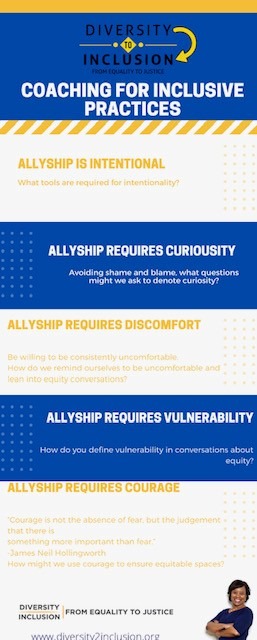
Uncomfortable Conversations About Race Is Where Real Change Begins

An Interview with Jessica M. Oladapo, founder, Diversity 2 Inclusion, Inc.

www.diversity2inclusion.org

“Initially, I ran from my calling,” Jessica Oladapo said with a smile in her voice. Those are surprising words coming from a person so passionate about her work with Diversity 2 Inclusion, an organization dedicated to training for cultural competence and cultural inclusion. “It’s absolutely my passion; it’s what I love.” That passion and love have transformed her into a highly sought-after expert in changing how companies and organizations view diversity and inclusion.  

Jessica’s path to expert wasn’t a short one. In 1998, she started her extensive education with degrees in psychology and African American studies at the University of Illinois at Chicago. By 2005, she had also earned a graduate degree in sociology from DePaul. After graduate school, Jessica started her family and became a stay-at-home mom. However, it wasn’t long before the pull of education brought her back to school as she decided to get another advanced degree in psychology. Admittedly, Jessica says it might not have been “the best to start a grad program when your child is five weeks old.” Regardless, she not only dove into classwork but also started serving as a social work case manager. Jessica realized how vital the work she was doing as a social worker was, but she felt that she spent so much time doing paperwork that she couldn’t meet the needs of the clients to the level she wanted. “I was looking for a way to touch as many people as possible, those who are most marginalized in our society based on race, class, gender, or immigration status. These people are marginalized not because of abuse necessarily, but neglect, neglect because of lack of resources.” This desire to directly reach people led her to teaching. “Teaching was my ‘thing’. I really loved being in the classroom and talking to future teachers, social workers, parents, and community leaders. My goal was to just help people understand their own thinking around diversity.”

By 2010, teaching was her full-time job. Jessica was teaching seven classes each semester. She also became the co-chair of a diversity committee at her college. Teaching gave her a platform to reach a wider audience, and people started asking her to lead public-speaking engagements. At first, Jessica shied away from these speaker requests, questioning how that fit with her goals and schedule. “Eventually I just gave in. When you have a calling, it’s best to give in to that calling,” laughed Jessica. She started doing community talks. In 2015, Jessica received a request to provide diversity training for a police department in a small town in Illinois. She recalls thinking “A police department? I don’t know. In the middle of Illinois?” Following her calling, she led the training believing it would be a one-time engagement. One training for the department became two. Other community leaders came to the second training for the police. She then got asked to talk to the local school district, and then to other community leaders. The business grew. Diversity 2 Inclusion, Inc. had been born.

Five years after that first speaking request, Jessica’s career path truly does seem to have been destined. Her expertise and insight on the issues of race and inclusion are in high demand at this very time. “It’s funny how many folks that have an impact say initially ‘No, absolutely not. It’s not my calling to be a spokesperson for a movement’,” Jessica muses. “And, then I kind of got here.” The violence and subsequent riots of the past month in our country and around the world have people seeking answers to the big questions: Why? Why did this happen? Why is the community so angry? Why didn’t I see what has been happening in my own community? Why has this gone on for so long? It’s not surprising that Jessica has seen an increase in the number of people reaching out to her for information to answer those big questions in the past few weeks. “What I’m always thinking is what’s the motivation for reaching out to me,” she explains. “I think right now a huge motivator is fear. People are afraid of saying the wrong thing, of offending colleagues, of losing employees. There’s a great deal of fear in the social unrest. Fear, in itself, isn’t a bad motivator. The problem is if we respond in fear only and don’t respond immediately. We all seek comfort, hope the fear goes down, and we go back to normalcy.” While fear is one powerful motivator for people reaching out to Jessica, another huge motivator is people coming to what she calls “this awareness” that systemic racism against black people is still a huge problem in our country. “There are people out there saying ‘I had no idea this is such a thing.’ And, I’m thinking ‘Where have you been? Black folks have been saying this forever. Where have you been?’”  

Where have we been? As business leaders, each of us can ask ourselves that question. And, more specifically, where are we going moving forward from this recent social uprising and spotlight focus on systemic racism? Jessica suggests that to plot a path forward as business leaders, we first and foremost need to be curious—curious about other people’s experiences and curious about our own thoughts. We need to ask ourselves how we’re responding, what personal social economic situations have led us to where we are, and how we are seeing someone else’s response through that lens. “Introspection is the most vital thing,” she advises. “If we aren’t being introspective, it’s really easy to blame people for their plight.”

Conversations about diversity and racism can be uncomfortable especially in the workplace. That uncomfortable space is where change begins. “I believe that effective business leaders have a responsibility to model empathy, grace, compassion and care, and inclusion,” says Jessica. By holding one-on-one conversations or organizing town halls, leaders can first listen to understand the experiences of those they lead. Through active listening, leaders can then develop systems and task forces to assist with everyday operations. An organization can state that it has agency and a stake in diversity, but there must be policies and practices in place to make sure there truly is systemic equality.

For organizations that have diversity policies and practices in place but struggle in recruiting diverse candidates, Jessica has some very basic insight: “You’re not looking in the right places or people of color don’t see your organization as a workplace that is inclusive. If you only go into white spaces to recruit, what are you going to get?” Recruitment leaders need to look at not only their recruitment locations but also the tone and language used in posting job positions and talking about the organization. “Institutional and systemic racism is revealed by the tone and language that is used in describing what kind of candidates you’re seeking to fill a position. If you use language like ‘professionalism’ what does that mean? Do I have to change my hair? Do I have to dress a certain way? You have to take a fine-tooth comb to the whole institution, language used, publications, interacting with the community, shifting the culture.”  

Through the shadow of the diversity crisis, Jessica does see a ray of light. “People are asking how can they be a good ally to people of color. I think that’s so powerful.” Countless companies, organizations, and individuals have issued statements in support of equality and anti-racism. The big question remains: Will there be lasting societal and organizational change? “I hope that it changes for good. In the immediate, it will change motivated by fear. There is a lot of pressure by people of color, particularly black folks, on leadership to make a statement. But, if you ain’t an ally, don’t make a statement. That’s performative ally-ship. After you have pressured the leader to make a statement, they make a well-written statement, hang it on the wall showing here’s the statement; here’s what we said. But by September, how well are you doing? A year from now, how are you doing? Hope is that the statement became institutionalized. That’s the hope.”

https://womeninstorebrands.org/3717-2/

  • « Previous Page
  • 1
  • …
  • 3
  • 4
  • 5
  • 6
  • 7
  • …
  • 13
  • Next Page »

Our 2018 Annual Meeting

What Our Members Say

"Just wanted to let you know I had a great time attending the Chicago WISE event last night. I met several wonderful men and women at the event and look forward to the November meeting too. Thanks for encouraging me to join!
~Amy Fattori,
Grecian Delight Foods, Inc.

2018 ANNUAL MEETING

Annual Meeting 2018

What Our Members Say

"Professional development, the webinars, what you learn, and what you take away is invaluable. Even doing this for 30 years, you still learn.”
~ Gayle DiMaggio, Director of Private Label Sales (Stremicks Heritage Food)(retired); 2016 Lifetime Achievement Honoree, Top Women in Store Brands

Our 2018 Annual Meeting

More Testimonials

“WISE has added value to the industry. It’s given a platform for people to step up and show how professional we are in the private label industry. It also gives an opportunity for us to show professional development. So it’s a great organization and it’s timely for the private label industry."
~ Greg Baskin, Hormel Foods ( retired )

Even More Testimonials

“I think, for me, it’s been connection, being able to connect to other people in the industry that I would have never been given the opportunity to connect with before. I think it’s drawn awareness to diversity and inclusion with women and others in store brands, and that’s been very beneficial to the industry.”

~ Cinda Sticklen, Commercial Director Supplier Quality, Mars Petcare US

More from the 2018 Annual Meeting

What Our Members Say

“WISE is just a wonderful organization, not only does it provide leadership skills, but it also takes women and diversity and brings it to a whole new level. "
~Ashley Palmerin, Social Media Lead (WISE)

2018 ANNUAL MEETING

2018 ANNUAL MEETING

More Testimonials

“I would absolutely recommend WISE. The one thing that I really like is that the webinars that happen middle of the week. It’s during my lunch hour, I take a break, and it gives me a perspective to go back and look at some of the things that maybe I’ve done, I’ve forgotten how to do, and it reminds me, 'Hey! I should be doing this again.' ”
~Dan Muller, National Sales Manager (Merisant)

2018 ANNUAL MEETING

EVEN MORE TESTIMONIALS

"I think it’s drawn awareness to diversity and inclusion with women and others in store brands, and that’s been very beneficial to the industry. I would absolutely recommend WISE to a colleague or a friend, or anyone who’s interested in private brands and just diversity in general.”
~Cinda Sticklen, Commercial Director Supplier Quality, Mars Petcare US

NIGHT OF DYNAMIC NETWORKING

What Our Members Say

"“WISE has added value to the industry. It’s given a platform for people to step up and show how professional we are in the private label industry."
~Greg Baskin (Hormel, retired)

NIGHT OF DYNAMIC NETWORKING

More Testimonials

"“I think, for me, it’s been connection, being able to connect to other people in the industry that I would have never been given the opportunity to connect with before. "
~Cinda Sticklen, Commercial Director Supplier Quality, Mars Petcare US

NIGHT OF DYNAMIC NETWORKING

EVEN MORE TESTIMONIALS

"Diversity and Inclusion are paramount to the future growth of business in general. Companies understand that their consumer base is changing and that their work force needs to reflect their consumer base to continue to grow. WISE is a positive example of how the PLMA recognizes the importance of helping foster a key resource group that can provide a forum to provide female leadership to our Industry."
~Greg Baskin Director, Hormel Foods (retired)

About Us

Women Impacting Storebrand Excellence™ (WISE) is a non-profit professional development organization within store brands. Studies have shown that gender balance in top leadership roles positively impacts business and financial performance.


Search Site

Copyright © 2026 · WISE Custom Child on Genesis Framework · WordPress · Log in